Kruger Day 4
Wednesday April 24
From the day we arrive on the planet
And blinking, step into the sun
There's more to see than can ever be seen
More to do than can ever be done
There's far too much to take in here
More to find than can ever be found
Keeps great and small on the endless round

After another early breakfast and sandwich making marathon,
we packed ourselves back into the cars and headed off for Mopani, again taking
the semi-scenic route. It was a long drive though, and took most of the day. We
searched for lions again, but to no avail. We drove across the Olifants River
again just to look at it since it is so pretty.

 |
| Hippos on the edge of the Olifants |
 |
| Young Giraffe |
We saw a bunch of hippos there too. They were sunning on the
side of the riverbank. They looked like rocks from far away. And we saw a croc
swimming in the river.
 |
| Never smile at a crocodile... |
And we saw a dead buffalo in the river as well. He had a wound on his neck, but we couldn't tell how he must have died.
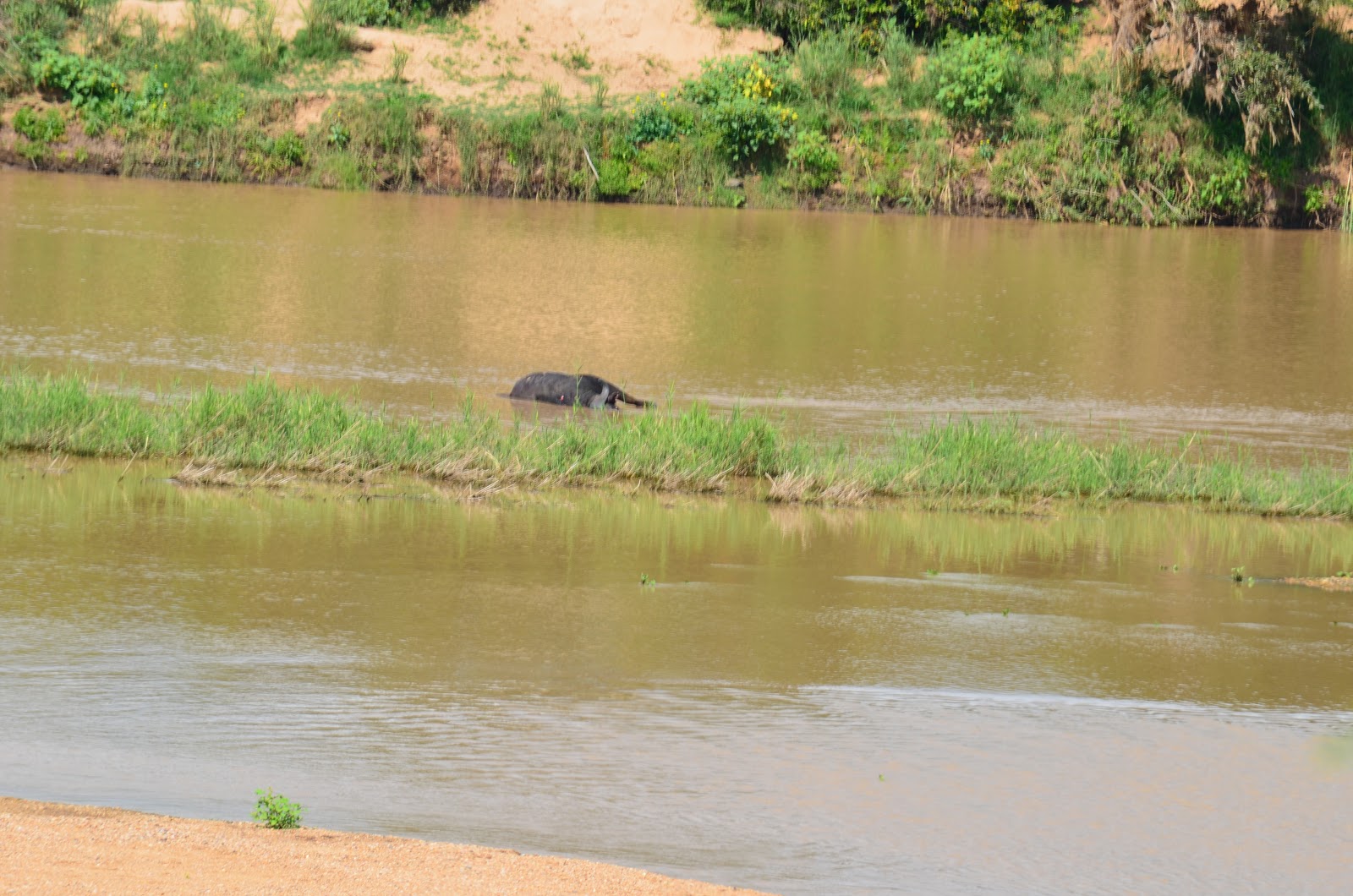 |
| Dead Buffalo in the River |
We also saw giraffes and some really rare kind of antelope
called roan antelopes. They are an extremely endangered species so it was a
rare treat to get to see them. Whooo!
 |
| Giraffe with his little oxpicker minions lined up on his back. |
 |
| Family of Roan Antelopes |
Also saw some elephants. Classic. We saw one really up close
and personal, and poor Xolani was freaking out. We even had to move out of the way so it wouldn’t run into
us. The elephant was behind the car, so Jimbo said to us in the back row, “tell
me if he starts running.” He started lumbering along at a slightly faster than
walking pace in our direction. And Neha shrieked, “He’s running!” So we drove
off. But it wasn’t more than a jog if that. But we all lived so it was ok. And it was exciting.
 |
| "He's Running!" |
 |
Baobab Tree, believed to be the oldest living
species on the continent |
We arrived at Mopani camp and went to look at the beautiful
giant Baobab tree on site. Baobabs are common up in the northern part and they
are so cool! We had a little bit of free time after we settled into our huts so
me and my two hut-mates did some abs. Too much sitting. It’s easy to forget
that you’ve been sitting for so long in Kruger because it’s amazing and
beautiful and interesting. Plus the company was really fun and we were always
having a great time, but still, it was too much sitting. So we did some abs
workouts. And then we went and
undid our abs by getting snacks at the bar before our afternoon game drive. It
was a short drive but we saw an elephant in must! And millions of Mopani trees.
These are the green trees that line the roadside here and give the region its
name. They are an indigenously invasive species. And make game difficult to
view.
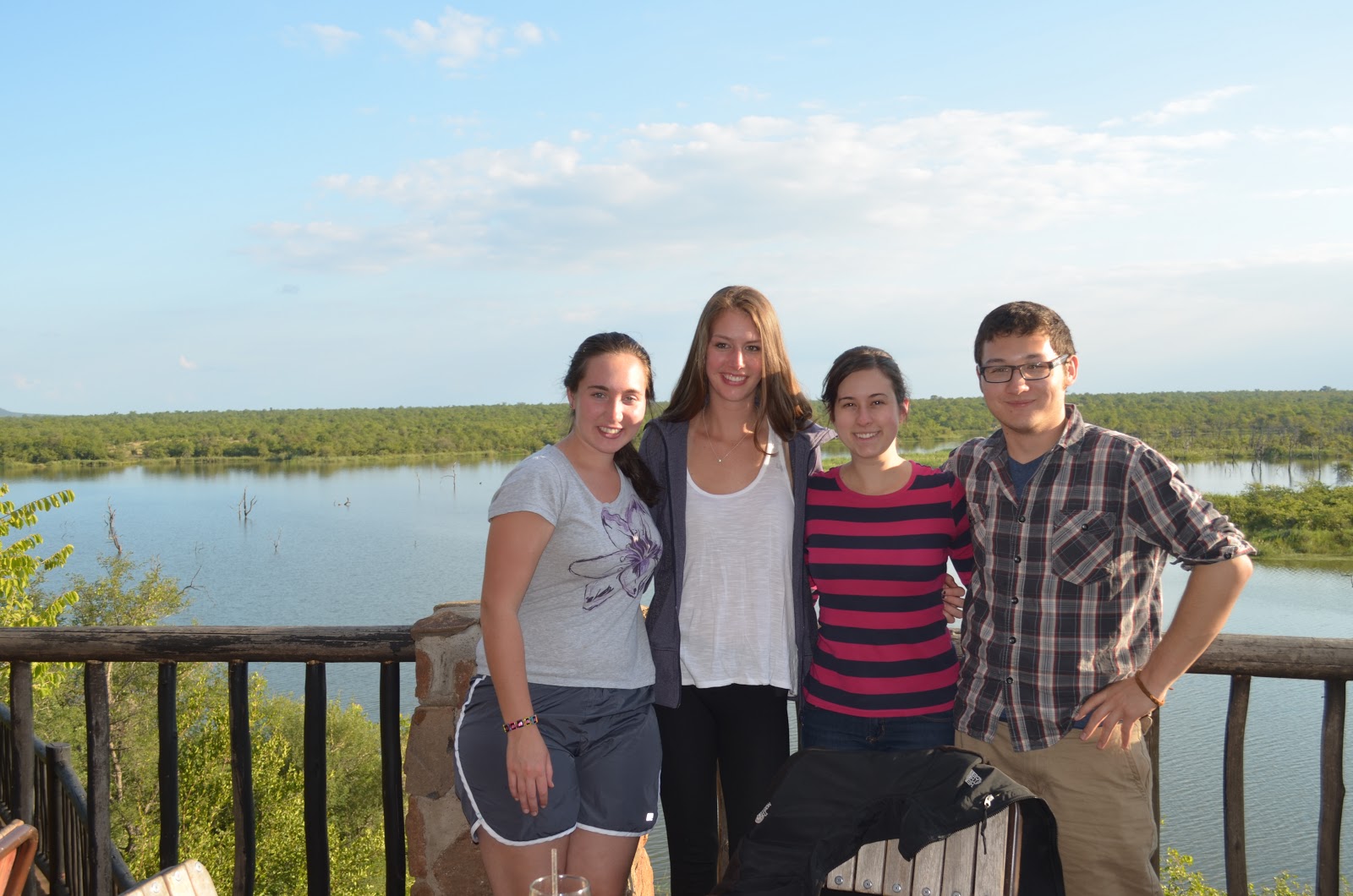 |
| @ Mopani Camp |
 |
| Really cool flower at the camp |

We also saw a family of elephants crossing the road right in
front of us. The cuteness of the baby was overwhelming. Ahhhhh!!!!!! I miss it
already. I wish that moment could last forever. But at least I have the
memories. Baby elephants don’t know what to do with their trunks so they tend
to just hang there limp or flop around. This little guy is a perfect example.
His mom looked pretty grumpy though, so we drove off pretty quickly after the
baby passed.
 |
| Is it safe to cross? |
 |
| "I don't know what to do with my trunk." |
 |
| Grumpy mamma |
We also saw the usual waterbuck and zebras and I found
myself startled at how quickly I had begun to take for granted an animal I’d
never even heard of.
But then, we were privileged to see what I’m pretty sure is
the most beautiful sunset that ever happened.


After yet another delicious dinner, David gave us a lecture
about Hamakuya where we would be heading the following day. He talked about
what we’d be doing in our water research and our homestays. There are twenty of
us, and there were four homes, so we divided into groups of 5. He told us that
since we’d been so well behaved and friendly and patient with each other all
week that he was so impressed that he’d let us choose our own groups. So we
decided to randomize it because we’re cool like that and are very mature. J So we arranged
ourselves in order of birthdays throughout the year. I was surprised I was the
first calendar birthday in the year. But my group was super cool. I mean
everyone is really awesome in my program, so it would have been fine, but the
particular dynamics of my group and our strengths combined to make a really
strong and adaptable group. Go team! My team included Hope, a pre-med psych
major from the Chicago area; Smitha, an accelerated medical education program
major from San Jose who is a junior but who is graduating in June and going to
Feinberg Med School in August; Katie, a pre-med bio major from the Chicago
area; Michelle, a communication studies major from New York; and me.
David designed a water research project for us to do for him
as part of his larger water research program when we were in our homestays. So
we had to learn how to use the GPS equipment we’d be using on our homestays. So
he had us do a scavenger hunt after our lecture. Each of us had the
geographical longitude/latitude coordinates of two points and had to go find
something hidden at each spot. It was pitch black also, so we had to use our
flashlights. Thank heavens for my Maglite. Definitely the brightest flashlight
in my whole program. Ask twenty overachieving Northwestern students to do a
scavenger hunt and what happens, the ferociously competitive side comes out in
everyone! It was hilarious. We literally sprinted back to the main house when
we found our objects: two rubber snakes. Really? Snakes? In the dark? That was
terrifying!!
Anyway, we won. Not that it matters… haha. The prize was a
box of Salty Crax, a kind of baked crackers that are amazing! During our whole
trip so far, we’d been munching on salty crax in the safari vehicles and every
time someone opened the snack box, salty crax were the most wanted food. We
didn’t fight over them, but we tried to politely figure out how to have as many
of them as possible without making enemies out of everyone else in the car.
After the hunt was over, I
couldn’t get to sleep fast enough. Kruger is the most fun place on earth, but
to do it right you have to tire yourself out. And our program directors made
very certain that that was the case for us all.


 We saw a herd of elephants drinking from a water collection
tank and it was another one of the cutest things I saw in Kruger. The little
ones had a hard time reaching their trunks up and over and they couldn’t see
what they were doing, so it was really comical. And the littlest baby needed
help from the mom to get water at all.
We saw a herd of elephants drinking from a water collection
tank and it was another one of the cutest things I saw in Kruger. The little
ones had a hard time reaching their trunks up and over and they couldn’t see
what they were doing, so it was really comical. And the littlest baby needed
help from the mom to get water at all. 


 We drove into Hamakuya and stopped at a mine’s c-store to stock up on anything we might need in the next few days. I can’t emphasize enough how much we stood out, the twenty of us American college students walking into a small convenience store in a rural area of the Limpopo province in South
 Our destination
was Tshulu Camp, David’s research headquarters for tropical water studies in
Hamakuya villages. When we arrived, we were split into four tents, according to
our groups for the homestays. However
“tents” barely applies to these structures. They were indeed tents, made from
cloth and with zippers for enclosures. But they were massive, had five beds in
them, and a bathroom and shower built at the rear. And there was a permanent
floor and deck made of nice hard wood. WHAT? Anyway, it was cool. We had about
an hour before dinner, so we explored the river near the camp, but kept a lookout
for crocodiles since they do inhabit that area of that river. We also saw a lot
of baboons and watched the sunset over the river.
Our destination
was Tshulu Camp, David’s research headquarters for tropical water studies in
Hamakuya villages. When we arrived, we were split into four tents, according to
our groups for the homestays. However
“tents” barely applies to these structures. They were indeed tents, made from
cloth and with zippers for enclosures. But they were massive, had five beds in
them, and a bathroom and shower built at the rear. And there was a permanent
floor and deck made of nice hard wood. WHAT? Anyway, it was cool. We had about
an hour before dinner, so we explored the river near the camp, but kept a lookout
for crocodiles since they do inhabit that area of that river. We also saw a lot
of baboons and watched the sunset over the river. 


 After another delicious
dinner, the volunteer coordinator and David’s research assistant, a former
volunteer from Ireland gave us the pre-homestay talk: instructions, what to
expect, etc. For the most part, it allayed my fears. But it definitely made me
nervous about some things. I tried not to worry and instead tried to relax and
not grow impatient during the almost-2 hour-long talk. After it ended, I walked
back to my tent and curled up in my cozy fluffy tent bed and instantaneously
fell asleep.
After another delicious
dinner, the volunteer coordinator and David’s research assistant, a former
volunteer from Ireland gave us the pre-homestay talk: instructions, what to
expect, etc. For the most part, it allayed my fears. But it definitely made me
nervous about some things. I tried not to worry and instead tried to relax and
not grow impatient during the almost-2 hour-long talk. After it ended, I walked
back to my tent and curled up in my cozy fluffy tent bed and instantaneously
fell asleep.


